
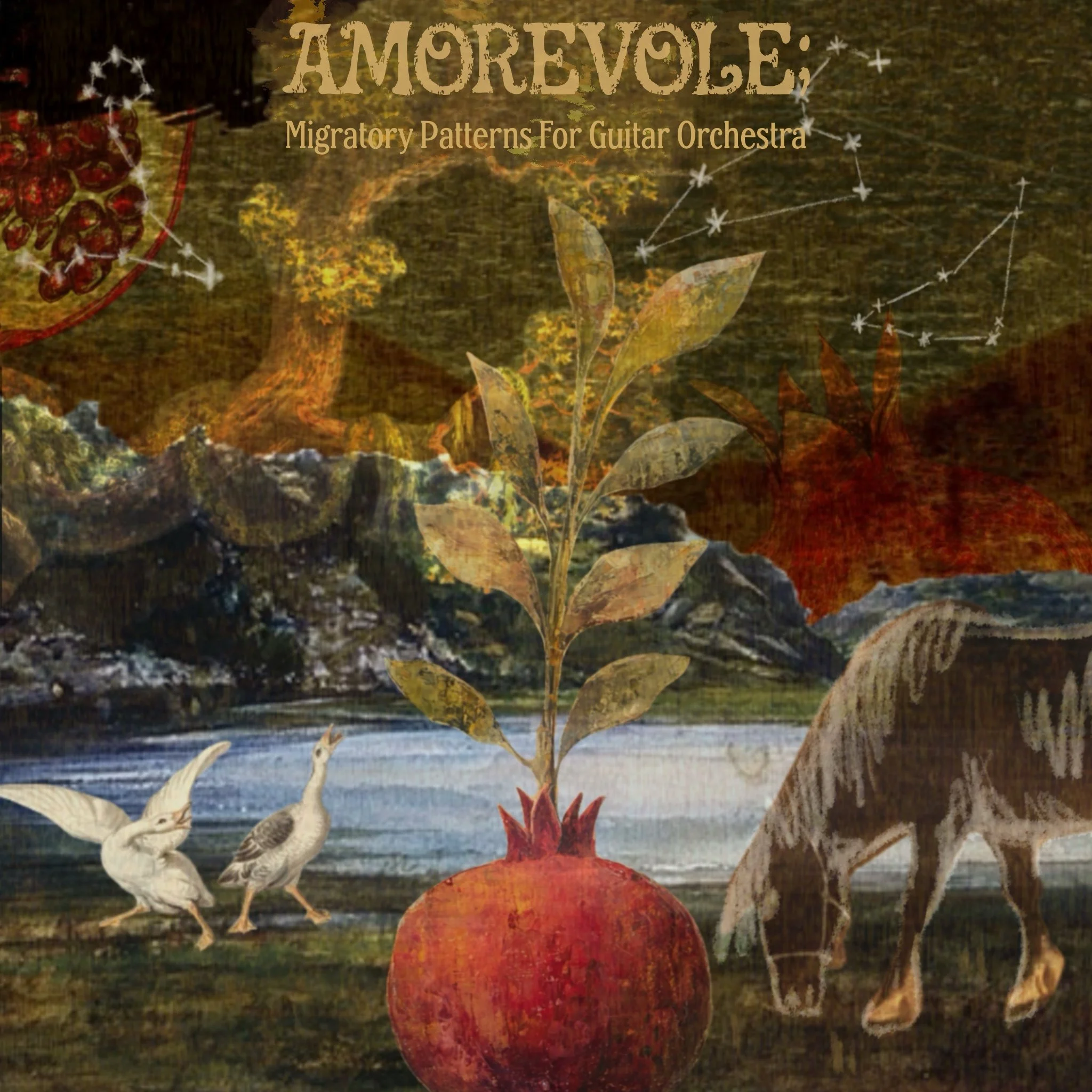
Album Art by Lexi McGraw
Track #2-#4 Myth of Persephone, Kevin Callahan
In 2022, soloist Xavier Jara with members of the US Guitar Orchestra (from the 2022 tour of New York City and Spain) assembled in Greensboro, NC to record Kevin Callahan’s Myth of Persephone. Under the direction of Dr. Kami Rowan and working with Storyteller Sound & ElectroMagnetic Radiation Recorders in Winston-Salem, NC, this smaller ensemble of USGO players put together a recording of this novel work.
Callahan’s musical interpretation of the Greek mythological story of Persephone places the listener in the center of their own garden of visual images motivated by a highly sensory auditory experience. Central to the annual Eleusinian Mysteries held in honor of the Greek gods Demeter and Persephone, this story has persevered from ancient times and still offers dramatic intrigue and fascination. Callahan’s mixing of compositional techniques and styles evokes a variety of moods and musical flow that makes this piece difficult to place within a single genre.
Movements: I. Descent
Movement I opens with Callahan creating a scenic backdrop for the listener. Persephone, the daughter of Zeus and Demeter and goddess of spring, is lying in a field as the sun breaks through the clouds. We are taken back in time by haunting vocals that conjure another world. As Persephone is picking flowers in the field, we hear Hades’ powerful chariots break through the ground from the Underworld. Having successfully abducted Persephone, Hades exhibits some swagger, which is programmatically communicated by Callahan through a funky blues section with a quote from Hendrix’s Foxy Lady. Movement I ends leaving the listener wanting more and curious about what is to come.
II. Search
Haunting and mysterious, the music in movement II takes us on Demeter’s forlorn journey searching for her daughter Persephone. The listener is transported to a barren landscape where Demeter is disconsolate and scouts the earth endlessly looking for her missing daughter. Here, we can feel the heartbeat and steps of a desperate mother who eventually refuses to ever enter Olympus again or bare fruits on the earth unless she is allowed to see her daughter again. Callahan’s use of evocative vocal and instrumental improvisation in this movement enables us to feel the depth of Demeter’s utter distress and hopelessness.
III. Ascent
Movement III begins with Hermês (Zeus’s messenger) knocking on the door to the Underworld in an attempt to strike a deal with Hades in return for his daughter. While human existence on earth weighs in the balance, Hades relents to Zeus’s request. We hear Persephone conflicted at first, but ultimately joyful to return from the Underworld. This is followed by Hades’ sadness from losing her communicated clearly through another soulful and sorrowful blues section. Movement III ends with the same punctuation as it began and promises the listener that not all is lost.
In Callahan’s Myth of Persephone no one gets everything they want, but everyone does get something. The tragedy of Persephone does not disallow the world to continue. Life goes on and hopefully we learn something here about how deeply music can tell a story and communicate the emotions of the characters within it. --Kami Rowan, Conductor
Xavier Jara (soloist)
Kami Rowan (conductor)
Connor Brady, Laura Boswell, JP Castillo, Noah Dabney,
Grace Elmer, Jesse Garcia, Kayla Hibbs, Morgan Stuart (guitars)
Laura Boswell, Lexi McGraw (vocals)
Brandon Walker (bass)
Recording Engineer: Doug Williams
Mastering Engineer: Dan Shearin
Studios: Storyteller Sound and ElectroMagnetic Radiation Recorders
Producers: Kevin Callahan, Kami Rowan, Laura Boswell, Doug Williams
Publisher: Yesler Way Music 2023
PRO: ASCAP
Track #1: We Are All In This Together, Mark Charles Smith
Mark Charles Smith wrote We Are All In This Together, a concerto for solo guitarist with guitar ensemble, in Fall 2017. Written for his student Brandon Walker for a Piedmont Guitar Orchestra tour of Iceland, the work has since been performed by soloists Jason Vieaux and Xavier Jara, with performances taking place in North Carolina, New York, Utah, Virginia, and Spain.
The piece is a single-movement work that begins with a slow, pensive section full of yearning. Out of the fog of mysterious, undulating chords rises an ominous melody played by the soloist on the bass strings. The sun comes out for a brief moment but recedes behind dark clouds. The opening material returns but then we abruptly embark on a new stage in our journey. The music is faster now, upbeat, and filled with light and joy. We immediately encounter a new melody (marked amorevole, or “lovingly”), first played by the soloist and which is also passed between the different parts of the ensemble. In a section filled with pizzicato riffs, guitar percussion and other effects, the soloist brings back a variation upon the previously “ominous” melody from the slow section, now lively and playful. The music quiets and the texture thins, and the soloist begins the cadenza, which reprises the main musical themes from throughout the piece. Gradually gaining in momentum and energy, the soloist brings back the “lovingly” theme, and then the full ensemble triumphantly returns to close out the piece.
Says the composer of the work: “each of us is a part of the greater whole of this existence, and the meaning of our lives is made manifest through our connections with each other, and how we treat each other. Whatever differences we have, they are outweighed by everything we share in common as humans of planet Earth. To quote David Mitchell from his novel Cloud Atlas: ‘Our lives are not our own. We are bound to others, past and present, and by each crime and every kindness, we birth our future.’” --Mark Charles Smith
Brandon Walker (soloist) Kami Rowan (conductor) JP Castillo, Connor Brady, Lexi McGraw, Emmett Edwards, Tucker Gamble (guitars) Casey Balser (contrabass guitar) Engineer: Doug Williams Audio editing/mixing: Joey Hirsh (@hirshproductions) Master: Daniel Shearin Recorded in 2025 at Fidelitorium Studio, Kernersville, NC Publisher: Zen Zesty Music PRO: ASCAP
Track #5 - Three White Geese, Composer Kevin Callahan
Three White Geese is written for guitar orchestra and bass by Kevin Callahan. It was commissioned by the Aaron Shearer Foundation for the centennial celebration of Mr. Shearer’s birth, and is premiered today at Carnegie’s Zankel Hall by the U.S. Guitar Orchestra conducted by Kami Rowan. Aaron Shearer, who became one of the world’s most respected and important guitar pedagogues, had a deep and enduring love for the guitar. As a young boy, and of poor and modest means, his only access to music was hearing his mother play church hymns on upright piano. Aaron’s love of music led him to trade three white geese for his first guitar. So began Mr. Shearer’s contribution to the guitar’s evolution. Aaron Shearer made a living teaching many styles, including popular and jazz idioms. This piece embraces the techniques of classical guitar that Mr. Shearer developed and advanced, while also invoking numerous musical genres that motivated him throughout his life. —KevinCallahan
JP Castillo (guitar, soloist)
Kami Rowan (conductor)
Casey Balser, Connor Brady, Lexi McGraw (guitars)
Brandon Walker (bass, guitar)
Jasming Jackson (background vocals)
Recorded in 2025 at Fidelitorium Studio, Kernersville, NC
Engineer: Doug Williams
Audio editing/mixing: Joey Hirsh (@hirshproductions)
Studios: Storyteller Sound and ElectroMagnetic Radiation Recorders
Publisher: Yesler Way Music
PRO: ASCAP
Track #6-#8: Signs, Alan Hirsh
Signs refers to the zodiac signs —Leo, Capricorn, and Pisces—each for a passed member in Hirsh's family. Each Sign musically depicts both zodiac and personal characteristics, as a sort of “In Memoriam.”
I.Leo opens with a clashing strum of two chords—the “Leo Roar”— a short-long rhythmic motif in dissonant sustain, which recurs throughout. Later it’s tamed and transformed as part of the lyrical second theme. The main theme, defined by its syncopated “rock” rhythm, is first heard by the soloist and then immediately transformed in the orchestra through a variety of treatments. The overall energetic drive of the movement points to Hirsh's father’s characteristics—strength, energy and leadership.
II. Capricorn in simple arch form, is a bittersweet dedication to Hirsh's older sister. The opening lyrical theme, characterized by child-like innocence, grows slowly and meditatively. With nostalgic yearning it builds to an animated middle section, only to be interrupted by a cathartic breakdown. An intimate though brief solo follows before rejoining the orchestra in a transformative recap of the main idea. The ascending approach to final cadence expresses a feeling of “letting go.”
III. Pisces celebrates love and creativity while musically depicting the symbols of water and the number “3”—for March, the birthday month of Hirsh's mother. “3” is realized in various ways: meter, phrasing, a 3-note thematic motif, and a recurring 3-chime clock effect. In the second theme, campanella (harp-like) writing and bleeding harmonies suggest a swirling waterscape as in Hirsh's mother’s watercolor paintings. The coloristic work with its hemiola rhythms in both vocal and guitar percussion drives to the ending with a climactic implosion—Alan Hirsh, 2025
Brandon Walker (soloist)
Kami Rowan (conductor)
Casey Balser, Laura Boswell, Connor Brady, Silviu Ciulei, Tucker Gamble, Kayla Hibbs, Maya Loncar, Brendan Lynch, Wesley Patterson (guitars)
Lexi McGraw (bass)
Engineer: Doug Williams
Audio editing/mixing: Joey Hirsh (@hirshproductions)
Master: Daniel Shearin
Recorded in 2025 at Fidelitorium Studio, Kernersville, NC
Publisher: guitarensemblemusic.com